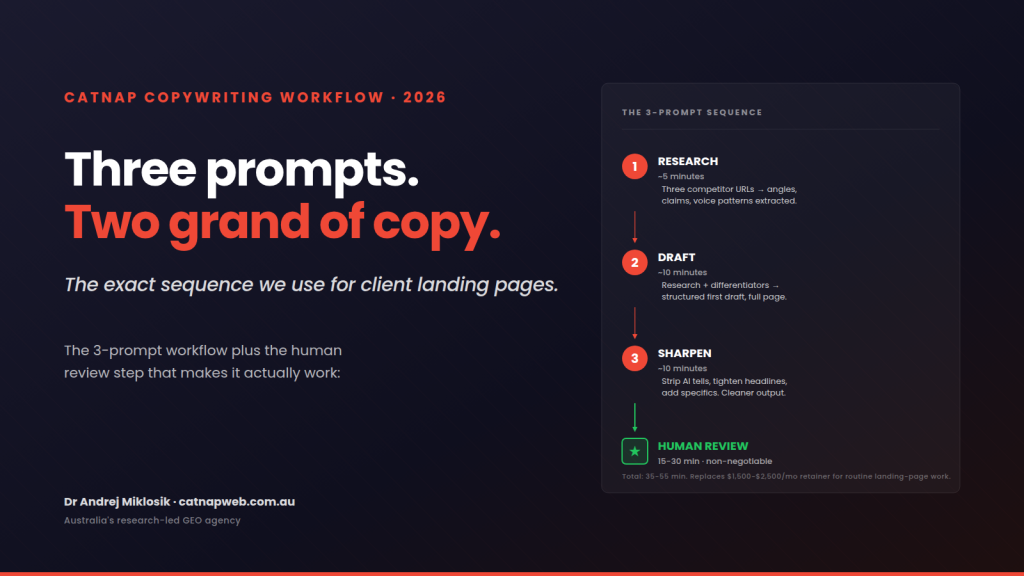
The 3-prompt workflow that replaces $2,000/month in copywriting
The exact 3-prompt sequence Catnap uses for routine landing-page copywriting. It takes 45 minutes end-to-end and replaces about $2,000/month of agency content retainer work. What it can replace, what it can't, and the human review step nobody talks about.
I'm going to share the exact three-prompt sequence Catnap uses for routine landing-page copywriting work. It's the workflow we run when a client needs a service page, a category page, or any commercial-intent landing page where the content patterns are well-understood and what's needed is a competent execution rather than original strategy.
This is going to be uncomfortable for some of the agencies we know — including some line items in Catnap's own offer. The workflow takes about 45 minutes end-to-end. It replaces about $1,500-$2,500/month of routine copywriting retainer work on a typical AU SMB site. That's a meaningful reallocation, and I'd rather you do it deliberately than have it happen to your agency relationship by accident.
Before the prompts, a few things this is and isn't.
What this workflow is for
This works well for: service pages with a clear offer, category pages on ecommerce sites, location landing pages (your service × a city), feature pages on SaaS sites, comparison pages where the framework is "us vs competitor."
This does not work well for: original strategic content (thought leadership, original research, opinion pieces), brand-voice-defining homepage copy, anything requiring deep customer empathy or specific case-study work, anything where exact wording carries legal or compliance weight.
The distinction matters. The workflow shines on the long tail of commercial pages where competence is the goal and originality isn't really the point. It fails on the smaller number of pages where every word is doing work and no shortcut can substitute for human judgment.
The three prompts
Each prompt builds on the previous one's output. The model I use most often for this is Claude Opus (4.5 or later) but ChatGPT works fine. I have not had good results with Gemini for this specific workflow — its drafts tend to need more rewriting than they save.
Prompt 1: Research (~5 minutes)
I'm writing a landing page for [YOUR SERVICE] aimed at [YOUR AUDIENCE]. The competitive landscape in this category includes these three sites:
1. [URL of competitor 1]
2. [URL of competitor 2]
3. [URL of competitor 3]
Please review each competitor page and extract:
• The primary angle each competitor takes (what they're claiming to be best at)
• The specific claims they make that aren't obviously empty (e.g., real numbers, real outcomes)
• The voice patterns and structural patterns common across all three
• What none of them are saying that the audience probably wants to hear
Output as a structured brief, not as prose.
The point of this prompt is to get the model to do the competitive landscape work that a human copywriter would otherwise do in the first hour of a project. You're not asking for a draft yet. You're asking for the briefing document a copywriter would prepare for themselves.
What you should get back: a clean structured analysis of the three competitor pages, with the patterns and gaps named. If the output is vague ("they all emphasise quality"), the prompt isn't yielding enough. Push back with: "Be more specific about the actual claims and language patterns. Quote exact phrases where helpful."
Prompt 2: Draft (~10 minutes)
Using your research from the previous step, write a complete landing page for our [SERVICE]. Here's what's different about us:
• [Differentiator 1, specific]
• [Differentiator 2, specific]
• [Differentiator 3, specific]
The audience is [describe in specifics — who, what they need, what they currently use].
Structure: hero with a specific outcome claim, three benefit sections each anchored to one of our differentiators, a section addressing the most likely objection, a section with social proof, a section explaining what happens next (the call-to-action). Around 800-1,200 words total. Use H2s and H3s, not just paragraphs.
Voice: [describe in specifics — direct, conversational, professional but not formal, etc.]. Australian English spelling. No em-dashes; use commas or full stops instead.
This is the longest prompt because it's where you commit to the angle. The differentiators have to be specific and real — not "we care about customers" but "every client is run by a founder, never a junior account manager." The audience description has to be specific — not "Australian businesses" but "AU SMB marketing managers at $1-5M ARR companies who are responsible for AI search visibility but don't have a dedicated SEO person." Voice has to be specific — not "professional" but "direct, plain-language, no jargon, sentences under 25 words."
The specificity is the whole game. Vague inputs produce vague drafts that need heavy rewriting. Specific inputs produce drafts that need light editing.
Prompt 3: Sharpen (~10 minutes)
The draft above is close. Now I want you to:
• Strip the AI tells: any sentence that starts with "In today's fast-paced world," any phrase like "harness the power of," any list of three abstract nouns ("efficiency, innovation, growth")
• Tighten every paragraph. Cut filler. If a sentence has more than 25 words, split it or shorten it
• Make every claim specific. If something is "fast", how fast. If something is "trusted by businesses", which businesses, how many
• Sharpen the headlines. The H1 should make a specific claim, not a vague promise. Each H2 should be a sentence that tells you what's in the section, not a vague label
• Keep the voice and structure of the draft. Don't rewrite the angle — just sharpen the language
This is where the workflow earns its keep. The Prompt 2 draft will read as competent-but-AI-generated. The Prompt 3 sharpen does roughly what a senior copywriter does on a junior copywriter's draft — strips the corporate fluff, makes the claims specific, tightens the language.
You can run Prompt 3 twice if you need to. The second pass usually catches things the first pass missed.
The human review step (the part vendors don't mention)
After Prompt 3, you have a draft that's about 80-85% of finished quality. It needs a human to do the last 15-20%. Specifically:
Fact-check every claim. If the draft says "trusted by 250+ Australian businesses," is that actually true? If it says "average client sees a 47% lift," where does that number come from? Hallucinations in this workflow are rare but not zero, and any hallucinated claim is a legal and reputational risk.
Add the proprietary signals. The AI doesn't know your founder's name, doesn't know your specific case studies, doesn't know your specific awards or media appearances. These need to be inserted manually. They're also the most valuable signals on the page from a citation/E-E-A-T perspective, so they're worth the time.
Read it out loud. Anywhere the rhythm breaks, you're rewriting. Anywhere your own voice would say something different to what the AI wrote, you're rewriting. This catches the residual AI tells that the sharpen prompt missed.
Final pass on the headlines and CTAs. These are the highest-leverage elements of the page. The AI's defaults are competent but generic. Five minutes of human attention on the H1, the H2s, and the button text is usually worth more than all the body-copy editing combined.
What this can and can't replace
The honest accounting on what gets displaced.
Can replace: the cost of routine landing-page copywriting for service pages, category pages, location pages, comparison pages, feature pages — i.e., the long tail of commercial pages where competence is the goal. Most agencies bill these at $400-$800 per page or roll them into retainers at $1,500-$2,500/month. For a business needing 2-4 pages a month, that's $20K-$30K/yr of potentially-displaceable spend.
Can't replace: the strategic work of figuring out what the page should say in the first place. The workflow assumes you already know your differentiators, your audience, and your competitive landscape. If you don't, the workflow will produce drafts that read well but say nothing important. That strategy work — figuring out the angle, the audience, the offer — is still a human-judgment task that doesn't shortcut well.
Can't replace: homepage copy, original research articles, opinion pieces, case studies that hinge on a specific client story, anything where the brand voice is the product (think of any business where the writing itself is the moat). For these, you still need a human writer who knows the brand and the audience.
The honest agency disclosure
Catnap's offer includes content production work. Some of that is the strategic kind that doesn't shortcut. Some of it is the routine kind that this workflow does displace. We've been moving the routine work onto this workflow internally since late 2025, which has let us reallocate the saved time into more strategic content for the same client retainers. We haven't reduced retainer prices yet because our clients haven't asked, and the freed time has gone into better strategic work rather than billable reductions.
If you're an existing Catnap client reading this and you want to negotiate that arithmetic, that's a fair conversation to have. The workflow exists, it works, and it should put pricing pressure on parts of every content agency's offer — including ours.
Want help working out which of your current copywriting spend this would replace?
Book a free 15-minute call. We'll look at your last quarter's content invoices and tell you honestly which pages this workflow handles well and which still need human writers. No pitch. Or see our GEO agency services.