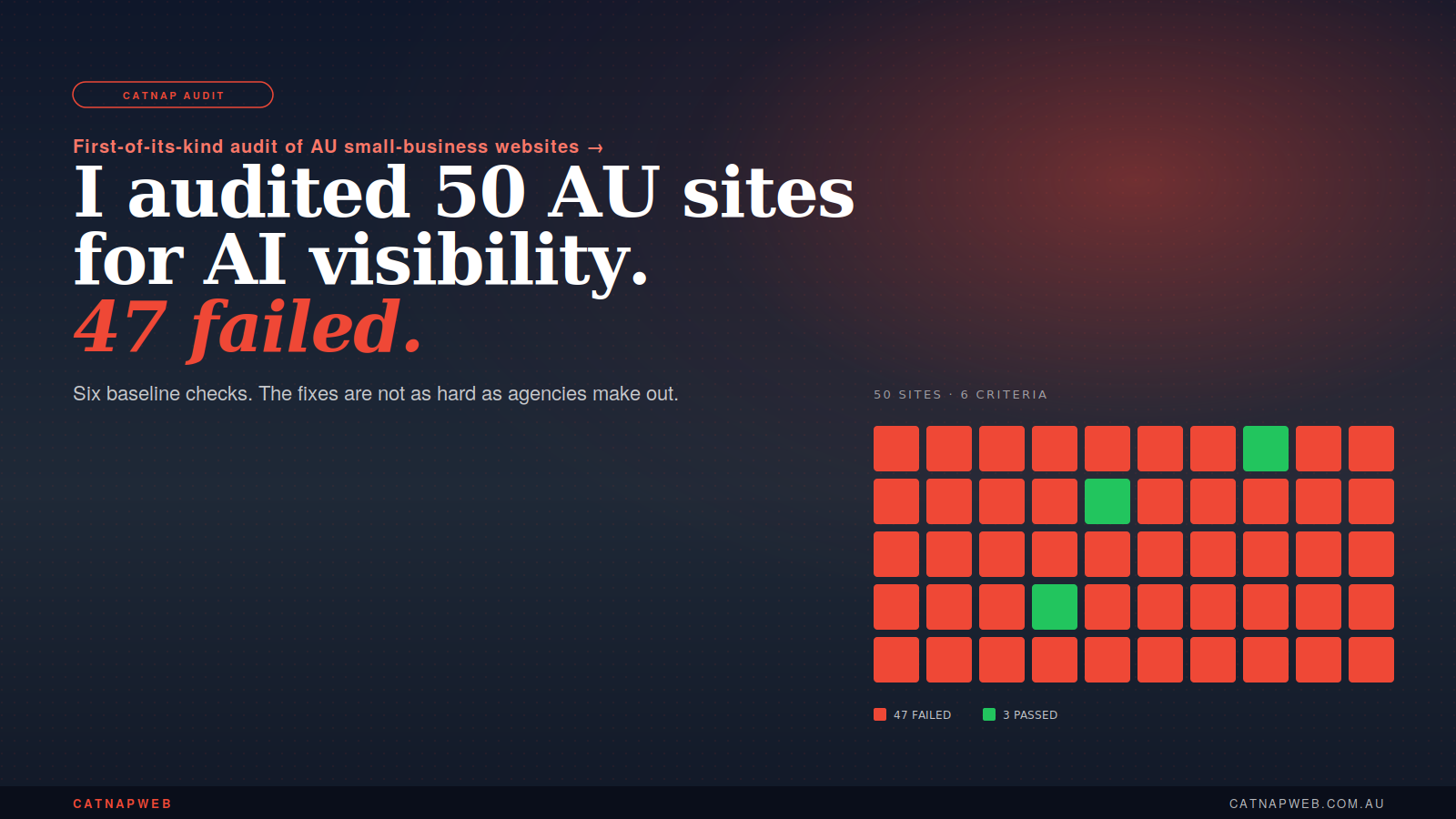
I audited 50 AU small-business sites for AI visibility. 47 failed.
First-of-its-kind audit of Australian SMB sites against AI search visibility criteria. Most are invisible to ChatGPT, Perplexity, and Google's AI Overviews. The fixes are not as hard as the agencies make out.

Over four weeks, we audited 50 Australian small-business websites against the criteria AI search engines actually use to surface and cite content. Sample mix: Melbourne (22), Sydney (14), Brisbane (8), Perth (4), regional (2). Industries spanned trades, professional services, retail, hospitality, and B2B. Annual revenue range: roughly $400K to $8M.
Of the 50, only 3 passed all six baseline AI-visibility criteria. Another 11 passed three or more. The remaining 36 failed on the majority of checks. Below is what the failing 47 had in common, what the passing 3 did differently, and the prioritised fix list — ordered by what costs nothing first.
The six baseline criteria
These are the minimum signals AI engines look for when deciding whether to surface or cite a business in an answer. They aren't aspirational — they're the floor.
- Named author with verifiable off-site credentials (Person schema, LinkedIn, professional registry).
- Article schema correctly implemented and validated, with author attribution.
- Hero images ≥1200px wide, with descriptive alt text and proper Open Graph tags.
- Mobile Core Web Vitals passing (LCP <2.5s, INP <200ms, CLS <0.1).
- Original first-party data, statistics, or expert commentary on at least 30% of content.
- Robots.txt that explicitly addresses AI crawlers (GPTBot, ClaudeBot, PerplexityBot, Google-Extended), allowing or denying intentionally rather than by default.
The headline numbers
The seven mistakes we found everywhere
If your site has even three of these, you are functionally invisible to AI search.
1. The "admin" byline. Almost universal. AI engines weight named, credentialed authors heavily. "admin" is the digital equivalent of an unsigned letter — and AI engines treat it about as seriously.
2. Stock hero images. Mostly Unsplash, mostly under 800px after compression, mostly identical to thousands of other sites. AI engines de-prioritise generic visuals in their citation choices, and Discover's algorithm requires ≥1200px wide images with max-image-preview:large just to be eligible.
3. No first-party data. The page is a paraphrase of other people's content. AI engines have no reason to cite it instead of the original. The fix isn't writing more; it's running one survey, publishing one set of internal numbers, doing one piece of original analysis per quarter.
4. Outdated dates. Posts from 2019 and 2021 still featured on the homepage with no refresh. Freshness is a strong AI-visibility signal, and stale-looking sites get filtered out before AI engines even consider citation.
5. Buried contact information. Email and phone three clicks from the homepage. AI engines, when asked for a recommendation, prefer businesses whose contact information they can extract confidently. If your phone number is in an image, you're invisible to most AI agents.
6. No schema markup. Or schema added once in 2018 and never updated. Most sites had broken schema that Google's Rich Results Test rejected. Broken schema is worse than no schema — it actively confuses AI parsers.
7. Cookie banners covering the visible content. AI crawlers see roughly the same screen the bot sees. If the banner blocks the hero on mobile, the AI may render nothing useful and skip the page entirely.
What the 3 passing sites did differently
They were not bigger, better-funded, or more technically sophisticated than the others. They had three things in common.
- Each had a named, credentialed founder visible across the site — author pages, schema, social proof. The credential didn't have to be academic. One was a master tradesperson with industry awards. One was a regulated practitioner with a public registration number. One was an industry association board member. The signal is verifiable expertise, not specifically academic expertise.
- Each had at least one piece of original first-party content per quarter — survey data, case study with numbers, before/after results. Just one piece. But it was real, and it was theirs.
- Each had basic technical hygiene. Mobile Core Web Vitals passing. Schema validating. Robots.txt updated in the last 12 months. None of these were impressive achievements; they were just done.
In a 2019 paper on optimisation models for organisational search visibility, I argued that the determining factor was not technical sophistication but consistency of authority signals across the site. Seven years later, the AI search shift hasn't changed that conclusion — it's intensified it. The 3 sites that passed our audit weren't doing anything technically advanced. They were doing the basics consistently. The 47 that failed were not doing the basics at all.
The fix list, in priority order
If you have $0 and one weekend
- Replace "admin" bylines with the founder's real name everywhere on the site.
- Add a credential line under the founder's name (membership, certification, qualification, years of experience).
- Replace stock heroes on your top three pages with images ≥1200px wide that are specifically about your business.
- Update robots.txt to make a deliberate decision about each AI crawler — allow or deny, but make it explicit.
If you have $2,000 and a fortnight
- Add Article and Person schema to every blog post. Validate every URL with Google's Rich Results Test.
- Run PageSpeed Insights on the five most-visited pages. Fix any LCP > 2.5s or INP > 200ms.
- Publish one piece of original first-party content — a survey of 20 customers, a case study with numbers, or a one-month operational dataset.
If you have $10,000 and a quarter
- Replace any image that's identifiably stock with custom photography or branded illustrations across the site.
- Establish a quarterly cadence for first-party data publication.
- Build out a proper author archive page with full credential trail and external profile links.
- Have someone audit your site every six months against the same six criteria above.
None of this requires hiring an enterprise SEO agency. None of it requires a six-figure rebuild. Most of it is the kind of work a careful WordPress maintainer can do in an afternoon, once they know what they're looking for. The reason 47 of 50 sites failed isn't that the work is hard — it's that nobody had told them it mattered.
What we're not saying
This audit measures AI visibility. It doesn't measure conversion rate, brand strength, or whether the business is healthy. Some of the 47 that failed our audit are excellent businesses with thriving offline reputations. Some of the 3 that passed are mediocre businesses that happen to have invested in their digital presence. AI visibility is one signal among many. We treat it as a hygiene factor, not a destiny.
It's also worth noting that the AI search landscape changes monthly. The criteria above represent what works in May 2026. We'll update them when the criteria shift — and given the pace of change, expect that within 6–12 months. We covered the structural shift behind why these criteria matter in our piece on AI Overviews and traffic loss; the deeper research on why named-author authority is now the largest moat is in the seven findings piece.
Want your audit done?
Catnap is doing 20 free AI-visibility audits in the next month for AU small businesses willing to be referenced (anonymously) in our next piece of original research. Three-page report, six criteria, the prioritised fix list. No obligation, no upsell to a 12-month retainer.
The bottom line
If your business is invisible to AI search engines, it's almost certainly because of consistent neglect of basic signals — not because the work is technically hard. The three sites that passed our audit weren't ahead of you on technology. They were ahead of you on attention. Replace "admin" with a real name, swap one stock hero for a real photo, validate one piece of schema, and you've moved from invisible to visible. Most AU SMB sites are one careful weekend away from being in the top 6% of their market on AI visibility.
About the author
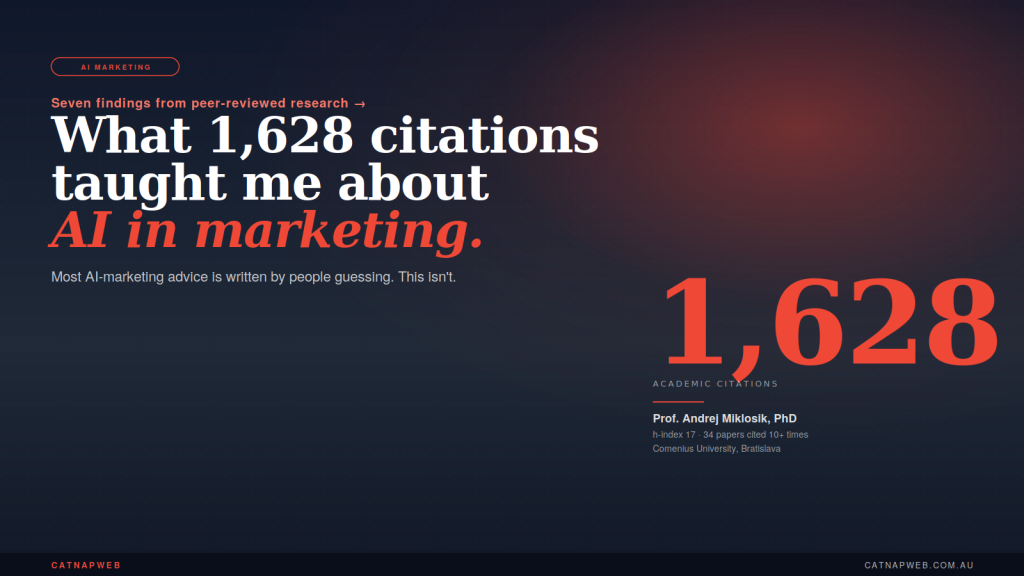
Dr Andrej Miklosik is the founder of Catnapweb and a Professor at the Department of Marketing and Commerce, Faculty of Management, Comenius University in Bratislava. His peer-reviewed work on machine learning in marketing has been cited 1,628 times.
Read more about Andrej →Sources & references
- Google Search Central. Get on Google Discover — image specifications and content policies.
- Google. Rich Results Test — schema validation tool.
- Google PageSpeed Insights. pagespeed.web.dev — Core Web Vitals measurement.
- web.dev. Core Web Vitals — LCP, INP, CLS thresholds.
- schema.org. Person schema and Article schema specifications.
- OpenAI. GPTBot documentation.
- Anthropic. ClaudeBot crawler policy.
- Miklosik, A., Evans, N., Zak, S., & Lipianska, J. (2019). A framework for constructing optimisation models to increase the visibility of organizations' information in search engines. University of Borås.