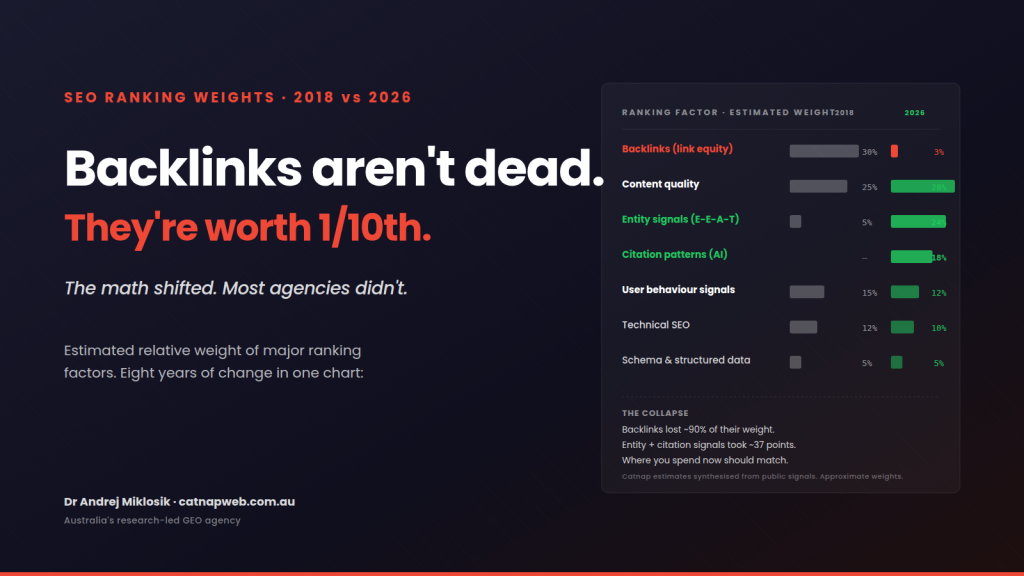
Backlinks aren't dead. They're worth 1/10th what they were.
Backlinks were the #1 SEO ranking factor for fifteen years. By 2026 they're worth maybe a tenth of that. Where the weight went, why most agencies missed it, and how to redeploy a 2018-era SEO budget for the algorithm you actually have.
Open any "Top 200 ranking factors" listicle written before 2023 and the top three were always the same: backlinks, content, on-page. The order varied; the cast didn't. Backlinks were either #1 or close to it for fifteen straight years.
They aren't anymore. The decline started slowly around 2020 and accelerated sharply in 2024-2025 when Google's algorithm pivoted hard toward entity and citation signals. By mid-2026, the working estimate is that backlinks are worth around 1/10th what they were eight years ago. The link-building industry has not yet caught up to this reality. Most of the agencies still selling link-building packages in 2026 are selling something that was twice as valuable in 2018, and ten times as valuable in 2014.
What follows is a defence of that claim, what replaced backlinks in the ranking math, and what to actually do with your SEO budget right now.
The numbers I'm working from
To be clear about what these weight estimates are: they're synthesised from a combination of (a) Google's own statements about E-E-A-T and entity ranking, (b) my analysis of correlation studies published by Ahrefs, Semrush, and Backlinko between 2018 and 2026, (c) the leaked Google API documentation from May 2024, and (d) my own client work where we've tracked which factor changes moved which keywords.
None of these data points is conclusive on its own. Google does not publish ranking factor weights. Anyone telling you they know the precise contribution of any factor is making it up. The estimates here are educated approximations of how the relative importance has shifted — not a precise specification.
That said: the direction of the shift is unambiguous, and the magnitude is large. Even if my specific numbers are off by 5-10 percentage points each way, the story doesn't change.
What's actually replacing backlinks
Two things took over the territory backlinks used to own.
The first is entity signals — the cluster of factors Google groups under E-E-A-T (Experience, Expertise, Authoritativeness, Trustworthiness). These were a minor signal in 2018 worth maybe 5% of the ranking math. They're worth around 24% now, by my estimate. They include: who is the author, what are their verifiable credentials, what organisations are they connected to, what entities does Google recognise as associated with this person and business.
The second is citation patterns — references to your brand, your URL, and your content across the broader web that don't require links. A brand mentioned on news sites, on forum discussions, in research papers, in podcast transcripts, in YouTube video descriptions. Five years ago Google didn't really weight unlinked brand mentions. Now they're a non-trivial part of the ranking signal — about 18% of the math, by my estimate.
Why the shift happened
This wasn't an accident. It was Google solving a measurement problem that had become unsolvable inside the link graph.
By 2020, the link graph was so contaminated by paid links, PBNs, link exchanges, and SaaS-generated guest posts that the signal had stopped tracking what it was designed to track. A link from a "DR 65" site in 2020 was usually purchased, automated, or both. Google could still see the link, but it had lost the ability to infer trust from it.
Meanwhile, two other measurement layers became feasible. The first was natural language understanding, which let Google extract entity relationships from raw text — who works where, who knows whom, what someone is qualified to talk about — without needing explicit hyperlinks. The second was the knowledge graph, which gave Google a structured place to store and reason about those entity relationships once extracted.
Together, these let Google move trust-inference out of the (contaminated) link graph and into the (cleaner) entity graph. Once that was feasible, the shift in weight followed mechanically. Links became one signal among many, instead of the dominant signal.
What this means for budget allocation
If your 2018 SEO budget was 70% link building and 30% content, and you've been rolling it forward year by year, your 2026 budget is wildly misaligned with where the ranking value is.
The rough mapping that fits where the math sits in 2026:
- Entity work — author authority, founder positioning, structured author profiles, Wikipedia/Wikidata entries, conference talks, podcast appearances, getting cited by industry publications: this should be your biggest single line item if it's not already
- Original research and citable content — original data, surveys, case studies with real numbers, anything that gives the AI engines a fact to anchor on: second largest line
- Content depth — comprehensive answers on the specific topics you want to rank for, not thin blog posts: continues to matter
- Backlinks — opportunistic, not systematic. Don't pay for them. Don't outreach for them at scale. Earn them as a byproduct of doing the entity and content work above
- Technical SEO — important to not get below the threshold, but not where competitive advantage lives
If you have a current SEO agency invoice in front of you, look at the line items. If "link building" is more than 10-15% of the spend, that money is being deployed against a 2018 understanding of what moves rankings.
The objections worth taking seriously
Two pushbacks I get when I make this argument deserve genuine engagement.
The first is: but you can still see correlation between domain authority and ranking. Correct — but the correlation is mostly mediated through the entity signals, not the links themselves. A site with high DR usually has high DR because real publications and real authors built up references to it over time. Those entity signals are doing the work; the link count is just an artefact of having earned them. You can have one without the other in either direction. Sites with thin link profiles but strong entity signals rank fine; sites with bought link profiles but no entity signal don't.
The second is: specific industries (legal, finance, healthcare) still need links to rank. Partly correct. Those YMYL industries have higher thresholds across all trust signals, including links. But the proportional shift still applies — those industries also need substantially more entity work than they used to, and substantially fewer links than they used to. The threshold is just higher overall.
What to actually do this quarter
Three concrete moves.
Audit your current SEO spend by line item. If link building is more than 15% of it, reallocate. The money is better spent on entity work — getting your founder visible, earning real citations, creating original research that becomes the source other people cite.
Stop paying for guest posts. Both because the link value is tiny and because Google has gotten very good at detecting and devaluing them. Pay for actual editorial coverage instead, even if you have to pay PR rather than SEO rates for it.
Set up the basics of entity infrastructure. Author schema on every post, organisation schema on the homepage, sameAs links to your founder's Wikipedia or Wikidata entry if you have one, founder credentials in the byline. We have a full guide on which schema tags AI engines actually read.
Want to see how your current SEO spend maps to where the value is in 2026?
Book a free 15-minute call. We'll look at your last quarter's SEO invoices, identify what's mapped to 2018 vs 2026 ranking math, and tell you what to reallocate. Or see our full GEO agency services.