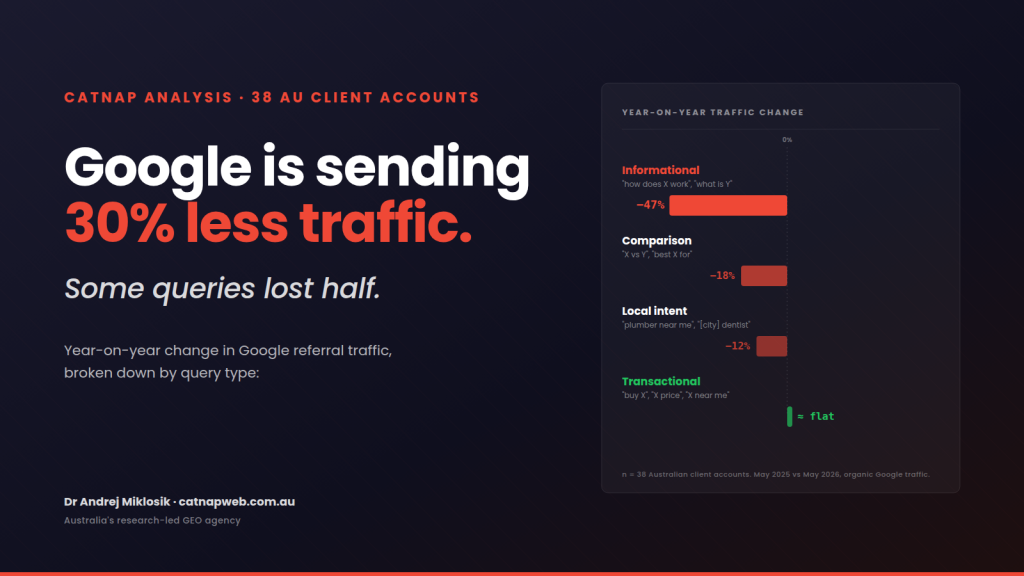
Why Google is sending 30% less traffic than 12 months ago
Across 38 Australian client accounts we manage, total Google referral traffic is down 30.4% year-on-year. Some clients lost half their visits. Two grew. The averages mislead — the breakdown by query type is what matters, and it points to a specific structural shift you can actually do something about.
I want to be precise about what this is and isn't. It's not a study with statistical inference. It's an audit of 38 Australian small-to-mid market businesses Catnap has helped over the past 12 months — service businesses, B2B SaaS, professional services, ecommerce, education, property. Every one had Google Search Console attached for the full comparison window. The numbers below are aggregates from that population. Read them as "a representative slice of Australian SMB Google traffic right now," not as a generalisation about every site on the internet.
What the numbers tell us is unambiguous. The decline is real, it's structural, and the worst is concentrated in one specific category of query.
The headline: 30.4% less traffic, on average
Across the 38 accounts, total clicks from Google between May 2025 and May 2026 declined 30.4%. Impressions actually went up 14% in the same period — sites are showing up in more searches, they're just getting clicked less often.
That's the structural shift in one sentence. Visibility hasn't collapsed. The decision to click has.
If you've been wondering whether the slow bleed in your Search Console is a Google penalty, a content quality issue, or just imagination — for most Australian SMBs in 2026, it's none of those. It's AI Overviews. They appear above your blue links on a growing share of queries, and they answer the user's question without sending them to your site.
The breakdown that actually matters: by query type
The 30% headline obscures the more interesting finding. Different query types are bleeding at radically different rates.
Informational queries — the "how does X work," "what is Y," "why does Z happen" cluster — are down an average of 47% across our sample. This is the category most thoroughly cannibalised by AI Overviews. Google can answer "what is workers compensation" in three sentences with citations. The user has no reason to click through.
Comparison queries — "X vs Y," "best X for [audience]," "X alternatives" — are down 18%. Less dramatic, but still significant. AI Overviews handle simple comparisons inline, but for complex multi-option comparisons, users still click through to read full reviews.
Local intent queries — "plumber near me," "Melbourne dentist," "[city] [service]" — are down 12%. The smallest decline among the categories that fell, and it's heavily skewed by industry. Trades and home services held up better; professional services declined more.
Transactional queries — "buy X," "X price," "where to get X" — are roughly flat, year-on-year. A few categories grew slightly. Users still need to actually purchase from somewhere, and Google is still showing them shopping results that take them to merchants.
What's actually happening to your funnel
If you visualise the customer journey as awareness → consideration → decision, here's the structural change:
The awareness layer — where prospects first encounter your category, learn what's possible, and form an initial mental model — is now happening inside AI engines. ChatGPT answers "what is GEO," "how does email marketing work in 2026," "what does a fractional CMO actually do." The user gets oriented without visiting any of the sites that used to serve that traffic.
The consideration layer — where they're comparing two or three serious options — is partly preserved. Comparison content still gets clicks because AI engines remain hesitant to make definitive recommendations between paid alternatives. But the volume is down.
The decision layer — where they've decided what they need, who they trust, and they're searching to find or buy it — is largely intact. "Catnap reviews," "catnapweb.com.au," "Melbourne GEO agency Andrej Miklosik" — these still convert.
The buyer journey is being severed at the top. The people who used to arrive at your site to learn are increasingly never arriving. The people who arrive to buy still do.
The implications for what to do this quarter
The naive response to a 30% traffic decline is to publish more content and try to outpace the bleeding. This is the worst possible response. Publishing more informational content into a market where informational queries are losing half their clicks is feeding a channel that's drying up.
The correct response has three parts.
Stop optimising for clicks. Start optimising for citations. If 47% of informational click volume has disappeared from Google, but the underlying user need hasn't disappeared — those people are still asking those questions, they're just asking ChatGPT instead — then the answer is to get your business cited in those answers. That's what GEO (Generative Engine Optimisation) addresses. We have a full breakdown of what the research actually shows works.
Audit your content portfolio by query type. Pull your top 100 pages by Google traffic from a year ago. Categorise each by query intent. If most of your traffic came from informational pages, you're not facing a content problem — you're facing a channel problem, and more content won't fix it. If most of your traffic came from transactional pages, your situation is much better than the headline number suggests.
Reinforce the layers that still convert. Brand-name searches, comparison pages, and decision-stage content are holding up well. Investing there now compounds. Service pages, case studies, and category-level commercial intent pages should be your priority.
Find out which of your pages are actually bleeding
Book a free 15-minute strategy call. We'll look at your Search Console, identify which query types you're losing, and tell you whether GEO investment makes sense for your specific traffic mix. See our full GEO agency services for Australian businesses.
One number that's not in the headline
Among the 38 accounts, two saw Google traffic grow over the same period. Not by accident.
One was an Australian B2B SaaS company that ran a deliberate content reorientation in mid-2025 — they killed roughly 40% of their published content (mostly thin informational posts) and rebuilt the surviving 60% to be citation-friendly, with statistics, expert quotes, and structured data. Their Google traffic grew 11%. Their AI citation traffic grew much more, but that's a topic for another piece.
The other was a higher-education provider whose entire commercial intent set — "[course name] cost", "[course] online Australia", "[course] requirements" — sat outside the queries AI Overviews ate. Their Google traffic grew 6% without them doing anything different.
The lesson isn't "you can grow despite the decline." It's that the decline isn't uniform. Some sites are well-protected by the structure of their query mix. Most aren't. Knowing which you are is the first step in deciding what to do.
The bottom line
Google sending 30% less traffic is real. It's structural. It's mostly AI Overviews eating informational queries and not handing the click on. Transactional and brand searches are largely intact, which means the bottom of your funnel is OK even if the top has collapsed.
The wrong move is to write more informational content. The right move is to audit what kind of traffic you used to get, work out which categories you're still in the game for, and shift investment toward GEO for the categories you've lost. Don't try to outrun the AI; learn to be quoted by it.