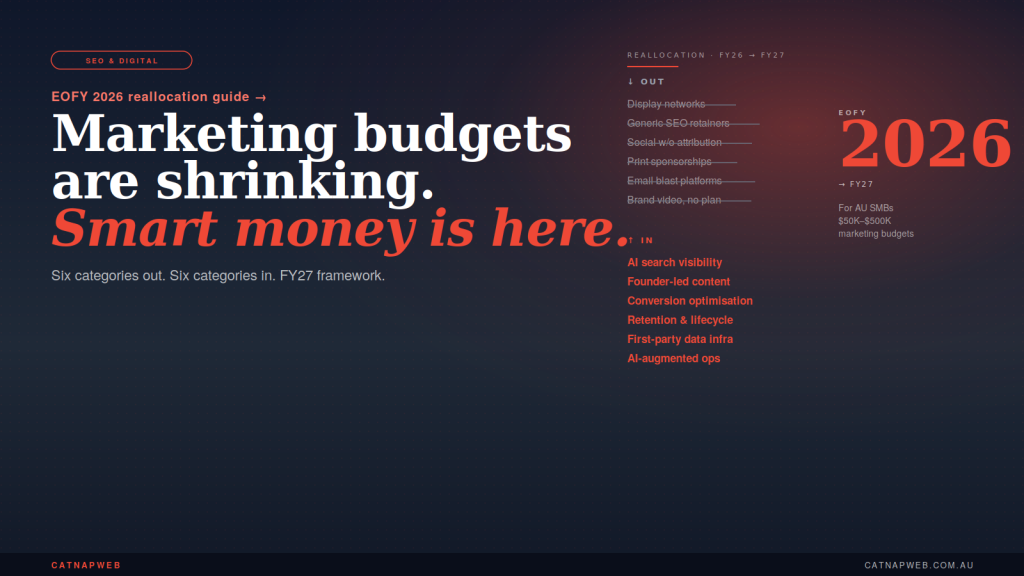
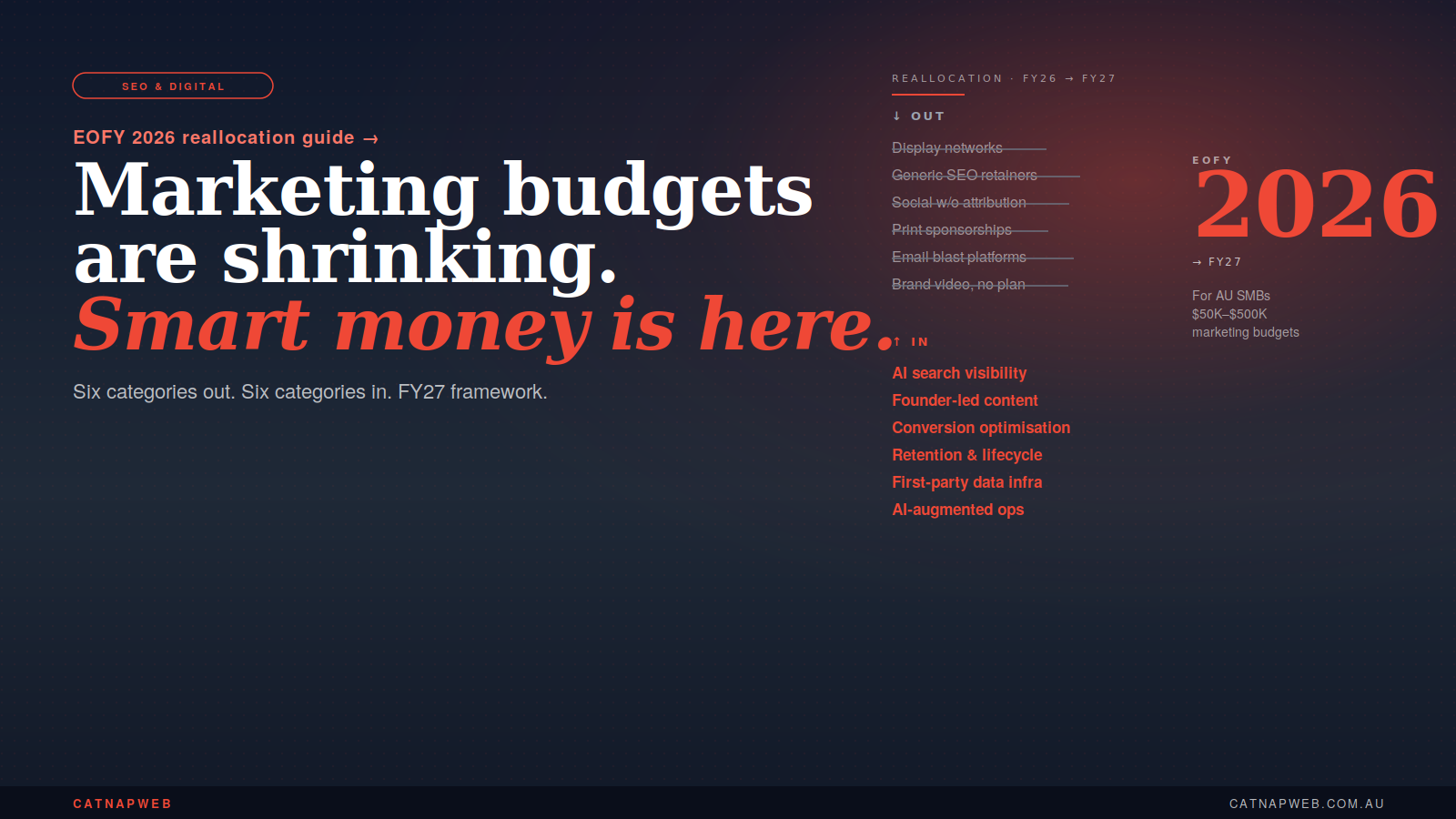
Marketing budgets are shrinking. Smart money is here.
EOFY 2026 is the tightest budget conversation most AU SMBs have had since 2020. The marketers I've talked to over the last quarter aren't asking what to add — they're asking what to cut, and where to redirect. Six categories of spend are leaving the budget. Six are pulling it in. Here's where the smart money is going for FY27.
The macro picture
Australian SMBs aren't cutting marketing spend out of panic. They're cutting it because the cost of capital is up, customer acquisition costs are at multi-year highs, and the channels that worked through the 2020-2023 boom have decayed in measurable ways. Digital ad spend in Australia is still growing — IAB Australia tracked the market at roughly $15B+ for 2025 — but the growth is concentrated in retail media, connected TV, and search, while display and standard social are flat or declining as a share of the mix.
What that means for the average AU SMB owner with a $50K–$500K annual marketing budget: the same dollar buys less reach than it did 18 months ago, and the channels delivering compounding returns are different ones than the channels that did three years ago. The reallocation is overdue.
The six channels where smart money is leaving
Not all cuts are equal. Some channels still work for some businesses; the categories below are where the average AU SMB is paying for declining returns and either doesn't know it or doesn't have time to do anything about it.
Display CTRs across the Google Display Network and standard programmatic continue their long decline — well under 0.1% in most categories. The fraction of impressions that even reach a human eye continues to fall as ad-blocking, viewability standards, and AI-summarised browsing reduce the moments of actual ad exposure. AU SMBs are pulling spend here because the math is no longer arguable: $1 in usually returns less than $1 in attributable revenue.
The kind of retainer that delivers a monthly report of "rankings improved" with no tie-back to revenue, no AI-search visibility tracking, and no entity-based content strategy. These retainers ranged from $1,500/month to $8,000/month for many AU SMBs. The work isn't always bad — but if you can't connect what the agency is doing to either revenue or competitive positioning, you're paying for activity, not outcome.
Posting on Instagram and LinkedIn three times a week at $2,000/month, delivering "engagement" metrics but no path from engagement to revenue. The work is real, the content is fine, the metrics are vanity. For most AU SMBs this is the easiest category to either kill or to dramatically restructure into something that ties to actual pipeline.
The "supporting our industry" line item that costs $5,000–$25,000 a year and has been on the budget since the founder joined the trade association. For most AU SMBs the ROI is unmeasurable and the brand-building value, where it exists, is now better delivered through owned-media content and AI search visibility. This isn't a hard cut for every business — but it's a default question for FY27.
Not email itself — mass-broadcast email to an unsegmented list. Open rates on Australian B2B blast emails are sub-15% for most senders and falling. The shift isn't cancelling email; it's moving from broadcast platforms (Mailchimp basic tier) to behaviour-triggered systems where every send is segmented by buying stage. The total spend often goes up; the platform changes.
The $15,000–$60,000 brand video produced once, hosted on YouTube with no distribution plan, viewed by 800 people, mostly the company's own employees. AU SMBs are pulling this line out because the per-impression cost is staggering and the content rarely outlasts a single quarter of relevance.
The six channels where smart money is flowing in
Being cited in ChatGPT, Perplexity, Gemini, and AI Overviews. AU SMBs investing here are doing the work in three places: schema and structured data on their site, named entity content (Person, Organization, FAQPage), and content that explicitly answers comparison and recommendation queries. The category didn't exist in any meaningful way 18 months ago. It now consumes 10–25% of the marketing budgets I see at well-run AU SMBs.
Articles, podcasts, and short-form video produced by the actual founder or senior expert in the business, with credentials, citations, and tie-back to their professional background. The reason this is rising in budget priority: it's the content most rewarded by both Google's helpful-content systems AND by AI assistants' citation algorithms. Generic blog content from ghostwriters doesn't move the needle anymore. Founder content does.
If you can't grow traffic cheaply, get more revenue from the traffic you already have. CRO budgets are growing for AU SMBs because they're the cheapest path to revenue growth in a tight market — typical engagements cost $5K–$25K and produce conversion uplifts that pay back within 60–90 days. CRO work is small in absolute spend but high in compounding return.
Retaining a customer is roughly 5x cheaper than acquiring one — the textbook statistic that AU SMBs have known for years but rarely acted on because acquisition was cheap. Now that acquisition costs are up, retention is finally getting the budget it deserves. The line items: lifecycle email, in-app upsell prompts, churn-prediction analysis, customer-feedback systems.
Customer data platforms, consent management, server-side tracking, identity resolution. The reason this matters now: third-party cookies are dying for real, attribution is increasingly probabilistic, and AU SMBs that don't own their first-party data are paying ad platforms more to compensate for poor signal. The investment is unsexy — typically $10K–$50K to set up well — but compounds across every other marketing investment.
Not buying AI tools at random (see that article on the 17 tools I tried). Specifically: AI used to do the work that previously required a dedicated headcount — content drafting with editorial workflow, SEO research at scale, customer-support triage. The pattern is consistent: replace one marketing FTE worth of routine work with $500–$1,500/month of AI tooling, redeploy the FTE to higher-judgement work.
My 2019 paper on machine learning-based analytical tools in digital marketing (IEEE Access, 293 citations) found that marketing technology adoption success is predicted more strongly by organisational discipline around measurement and outcomes than by the sophistication of the tools themselves. The implication for FY27 budget reallocation: the businesses winning aren't the ones moving fastest to AI or to the next channel. They're the ones with clearest measurement discipline, who can see exactly where every dollar lands and reallocate accordingly. The channels matter less than the framework you use to decide which channels.
A practical framework for your FY27 reallocation
Before you commit to specific reallocations, three questions to run every line item through:
Q1: Can you draw a line from this spend to revenue?
Not "rankings" or "engagement" or "brand awareness." Revenue. If the answer is no, the spend either needs measurement infrastructure added in FY27 (and then re-evaluated in FY28) or it needs to come out. There's no middle ground anymore — unmeasured spend is the first thing that should go in any tight-budget cycle.
Q2: Is this spend defending against a moat or building one?
Some channels defend an existing position (paid search on your branded keywords). Others build a new one (founder-led content that compounds across years). In tight budget cycles, defensive spend stays at whatever level keeps the moat. Building spend goes either up sharply (if the moat is worth building) or to zero (if it isn't). The middle — "we're building a brand presence" with no clear outcome — is where wasted budget hides.
Q3: What's the lag between this spend and its return?
Paid acquisition returns in days. SEO and content return in months. Brand-led organic returns in years. The temptation in tight budget cycles is to over-weight short-lag channels, which works for one quarter and starves the long-lag ones that produce the next three years of growth. The healthy budget has a mix across lag horizons, and the discipline is not to cut the long-lag spend just because its return isn't immediate.
Not sure where your current spend is leaking?
Our free AI marketing maturity audit looks at your current channel mix, attribution clarity, and AI search visibility. You get a three-page report with the spend categories likely to underperform in FY27 and where to redirect. AU SMBs only. No upsell to a 12-month retainer.
The bottom line
Marketing budgets are shrinking in real terms for most AU SMBs right now. The question isn't whether to cut — it's whether to cut blindly or to use the budget pressure as the forcing function for a reallocation you should have done eighteen months ago.
The six cut-candidates and six pull-in categories above aren't universal — your business may legitimately need to keep some of the cut column or pass on some of the pull-in column. But the pattern is consistent across the AU SMBs I see doing this well: they're moving from spend categories where ROI is unmeasurable to categories where it's clear, from channels that worked in 2022 to channels that work in 2026, and from broadcast to compounding.
If you want to see what the EOFY reallocation looks like through a different lens, the eight SEO tactics that stopped working in 2025 covers the supply-side equivalent — which work specifically your current agencies should have stopped doing already.