Local SEO
Local SEO for Tradies: How to Rank in Google Maps Across Every Suburb You Service
A step-by-step guide for Australian trade and service businesses — Google Business Profile, suburb pages that actually rank, citations, reviews and local links.

Key takeaways
- Google ranks local results on relevance, distance and prominence. You can’t change distance — so win on the other two.
- Your Google Business Profile is the single most important local asset. Categories and services matter more than the description.
- Suburb pages work only when they’re genuinely useful. Templated pages that swap the suburb name are a liability.
- A brand-new Brisbane fencing domain reached 260+ monthly visits and 30+ monthly enquiries in nine months with no paid ads.
How Google decides who shows in the Map Pack
When someone searches “electrician near me” or “fencing Strathpine”, Google shows a map with three businesses above the regular results — the Map Pack. For most trades, that’s where the phone calls come from. Google publicly states that local results are based mainly on three factors.
Google’s three local ranking factors
| Factor | What Google means | What you control |
|---|---|---|
| Relevance | How well your profile matches the search | Categories, services, website content |
| Distance | How far you are from the searcher or the location searched | Very little — service areas and suburb pages help |
| Prominence | How well-known and trusted your business is | Reviews, links, citations, overall SEO strength |
Source: Google Business Profile Help — “Tips to improve your local ranking on Google”.
You can’t move your yard closer to every customer. What you can do is make your business the most relevant and most prominent option across the suburbs you serve — and the rest of this guide is about exactly that.
Step 1: Get your Google Business Profile right
Your Business Profile is the listing that appears in Maps. Most tradies set it up once and never touch it again. That’s an opportunity: an actively managed profile is one of the clearest prominence and relevance signals you can send.
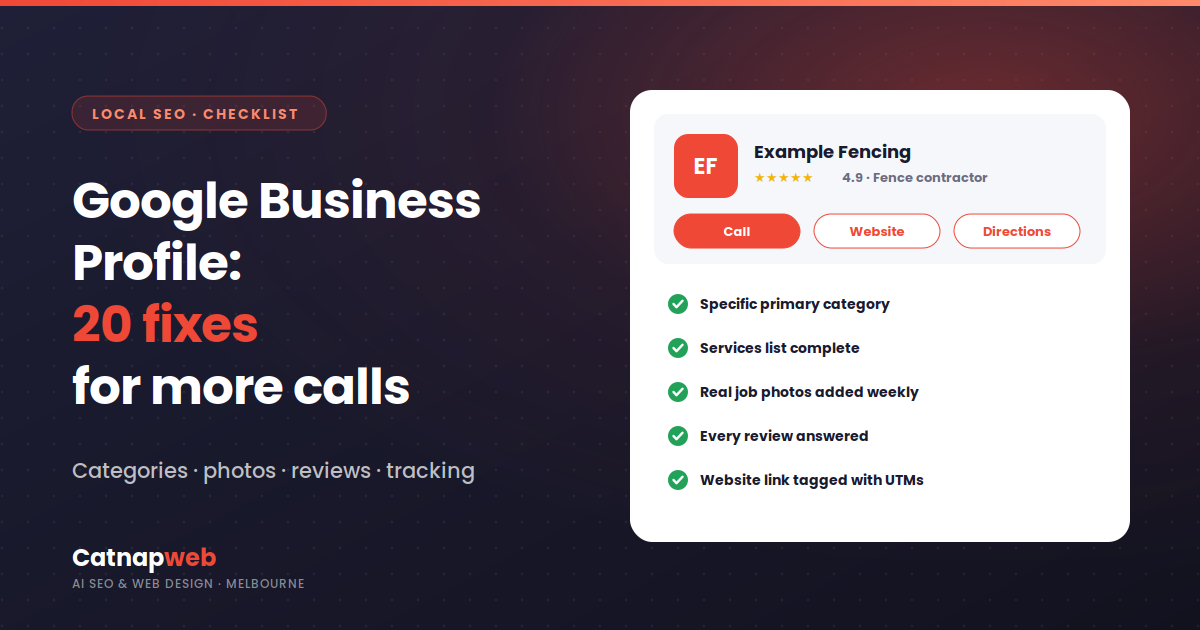
Business Profile essentials
- Primary category set to your core trade (e.g. “Fence contractor”, not “Contractor”)
- Secondary categories for real additional services only
- Services list filled in with every job type you want to be found for
- Service areas listing the suburbs and regions you genuinely cover
- Photos of real jobs, uploaded regularly — not stock images
- Posts showing recent work in specific suburbs
- Questions & answers seeded with the questions customers actually ask
- Hours, phone and website identical to your site and directories
Step 2: Build suburb pages that deserve to rank
Google can’t rank you for “fencing Aspley” if nothing on your website mentions Aspley. That’s why suburb or service-area pages work. But there’s a right and a wrong way to build them — and the wrong way can drag the whole site down.
Doorway page vs genuinely useful suburb page
| Templated doorway page | Useful suburb page | |
|---|---|---|
| Content | Same text, suburb name swapped | Unique copy about local conditions and jobs |
| Proof | None | Photos and short write-ups of jobs in that area |
| Specifics | Generic | Typical prices, council requirements, timeframes |
| Linking | Orphaned in a footer | Linked from regional hubs and related services |
| Schema | None | LocalBusiness and Service with areaServed |
| Result | Seen as low quality | Ranks, converts, supports the Map Pack |
A practical structure is a small number of regional hub pages (North Brisbane, Bayside, Inner South…) each linking to a handful of strong suburb pages. Start with the suburbs closest to you and with the most work, then expand outward as each page proves itself.
Step 3: Citations and consistent business details
Citations are mentions of your business name, address and phone (NAP) on other sites. They help Google — and AI assistants — confirm that your business is real and where it operates. The rule is simple: every listing should be identical.
Core platforms
- Google Business Profile
- Bing Places (also feeds Microsoft Copilot)
- Apple Business Connect (Apple Maps)
- Facebook business page
- LinkedIn company page
Australian trade directories
- hipages
- ServiceSeeking
- Oneflare
- Yellow Pages
- True Local
- Your industry association’s member directory
Step 4: Reviews — the factor you can improve every week
Reviews influence prominence and, just as importantly, which business a searcher clicks once all three are on screen. The tradies who win here aren’t the ones with the best work — they’re the ones with a system for asking.
Ask at the right moment
Ask on the day the job is finished, when the customer is happiest — not weeks later in a bulk email.
Make it one tap
Send your Business Profile’s direct review link by SMS. Every extra step loses reviews.
Reply to every review
Thank positive reviewers by name and job type; respond calmly and specifically to negative ones. Future customers read the replies.
Never pay or incentivise
Google’s policies prohibit offering incentives for reviews. Fake or paid reviews risk removal and profile penalties.
Step 5: Local links and mentions
Prominence also comes from being mentioned by other trusted local and industry websites. For tradies, the best opportunities are usually already in your contact list:
- Suppliers and manufacturers — many list approved installers or stockists.
- Industry associations — member directories carry real authority.
- Builders and trades you work with — preferred-contractor pages and project write-ups.
- Local sponsorships — sports clubs, school fetes, community events.
- Local news — notable projects, apprenticeships, community work.
Real results: a Brisbane fencing contractor
Ever Fencing came to us in mid-2025 with a brand-new domain — no search history, no backlinks and no organic traffic. We focused first on a local foothold around Brendale, then expanded suburb by suburb across Greater Brisbane, alongside Business Profile, Bing Places, Apple Maps and 50+ directory citations.
- ~0 → 260+Monthly organic visits in 9 months
- 30+Monthly enquiries from organic search
- 101KGoogle impressions over 12 months
- 0 → 24Referring domains
It’s not only new businesses. Saylec Electrical, a South-East Melbourne electrician with 15+ years of trading, had been stuck at position #6 in the map results for “Langwarrin electrician”. Suburb pages and Business Profile work moved it to #4 — read the Saylec case study.
How long does local SEO take?
Business Profile and citation fixes can move map rankings within weeks. Suburb pages typically take a few months to settle, and competitive metro areas take longer — especially on a new domain. We break down realistic timelines, with data from our own projects, in How long does SEO take?.
Your local SEO checklist
- Business Profile categories, services and service areas complete
- Real-world business name, no added keywords
- Identical name, address and phone on every listing
- Regional hub pages plus genuinely useful suburb pages
- LocalBusiness and Service schema with areaServed
- Review requests sent by SMS on the day each job finishes
- Every review answered
- Five local or industry links earned this quarter
Frequently asked questions
Can I rank in suburbs where I don’t have an address?
In the Map Pack, distance limits how far a profile reaches. In the regular results, useful suburb pages can rank you across your whole service area — which is why most tradies need both.
How many suburb pages should I create?
Start with the 5–10 suburbs where you do the most work and can show real jobs. Add more as each page proves itself. Quality beats coverage.
Do I need a website if I have a Google Business Profile?
Yes. Your website’s content and authority feed relevance and prominence, and it’s where suburb pages live. A profile without a strong website caps how far you can rank.
Do reviews affect rankings?
Google lists review count and score as part of prominence. Reviews also strongly influence which business gets the click once you appear.
Should I list a PO box or virtual office?
No. Google’s guidelines don’t allow PO boxes or virtual offices unless staffed during business hours. Service-area businesses should hide their address and list the areas they serve.
Does local SEO help with AI search?
Yes. AI assistants answering “near me” questions draw on business profiles, consistent listings, reviews and clear local content — the same foundations. See how to get recommended by ChatGPT.
Founder of Catnapweb and Professor at the Department of Marketing and Commerce, Comenius University. Author of 170+ research publications on AI in marketing and search visibility, cited 1,705 times. Full profile →